Prayer times where you actually are. The Qibla, to the degree. The whole Qurʾān to read, hear and memorize. Hadith, duas, dhikr, and lessons that start from the beginning if you need them to. Nothing to sign up for, nothing to pay, and nothing about you is ever sent to me.
Because the free one I was using put a banner ad under the prayer times and a popup over the Qibla. I did not want to see an advertisement above a prayer time, so I built the one I wanted: prayer, Qibla, the whole Qurʾān with a path for memorizing it, Tasbih, Hadith, and a garden that grows out of your own worship. No ads, no account, and nothing about you is ever sent to me.
No account, no purchase. So what is paying for it?
Nothing is. There are no ads, no subscription, and no purchase hidden anywhere inside it. There is not even a way for the app to take a payment.
It was built in one person's spare hours, and there is no server of mine for it to run on: your prayer times are worked out on your phone.
What happens the first time you open it, before you have decided anything.
Seven steps, and five of them are about your setup rather than about you: where you are, which calculation your mosque uses, whether you want the adhan reminder, which translation to keep for when there is no signal, and what to call you, which you can leave blank. Skip on the first screen ends the whole thing and drops you straight on today's prayer.
"Free · No account · Built for you" is the first line of the welcome screen, and there is nothing behind it.No account. So where does everything I do actually live?
On your phone, and nowhere else. Your settings, your streaks, your garden and your place in the Qurʾān sit on the device, so there is no login to lose and nothing of yours on anyone's server.
Changing phones is the fair question. Because it all lives on the device it travels inside your own encrypted iPhone or iCloud backup, and Settings can also write out a single backup file, which you can lock with a passphrase and carry across yourself.
Nothing below is a mockup. These are the real screens, most of them recorded live on a device.
Mizan works out the day's prayers from your own location, and shows you the one you are in rather than the one coming next. Pick your madhab and calculation method if you have a preference, or leave it alone and it picks the one your region uses.
What if these are not the times my mosque uses?
Then set it to the ones it does. Twenty-two published conventions to choose from, or your own Fajr and Isha angles, a madhab setting for Asr, and a rule for the high latitudes where the sun refuses to cooperate.
If your mosque still calls it two minutes later than that, you can nudge each prayer by hand, up to half an hour either way.
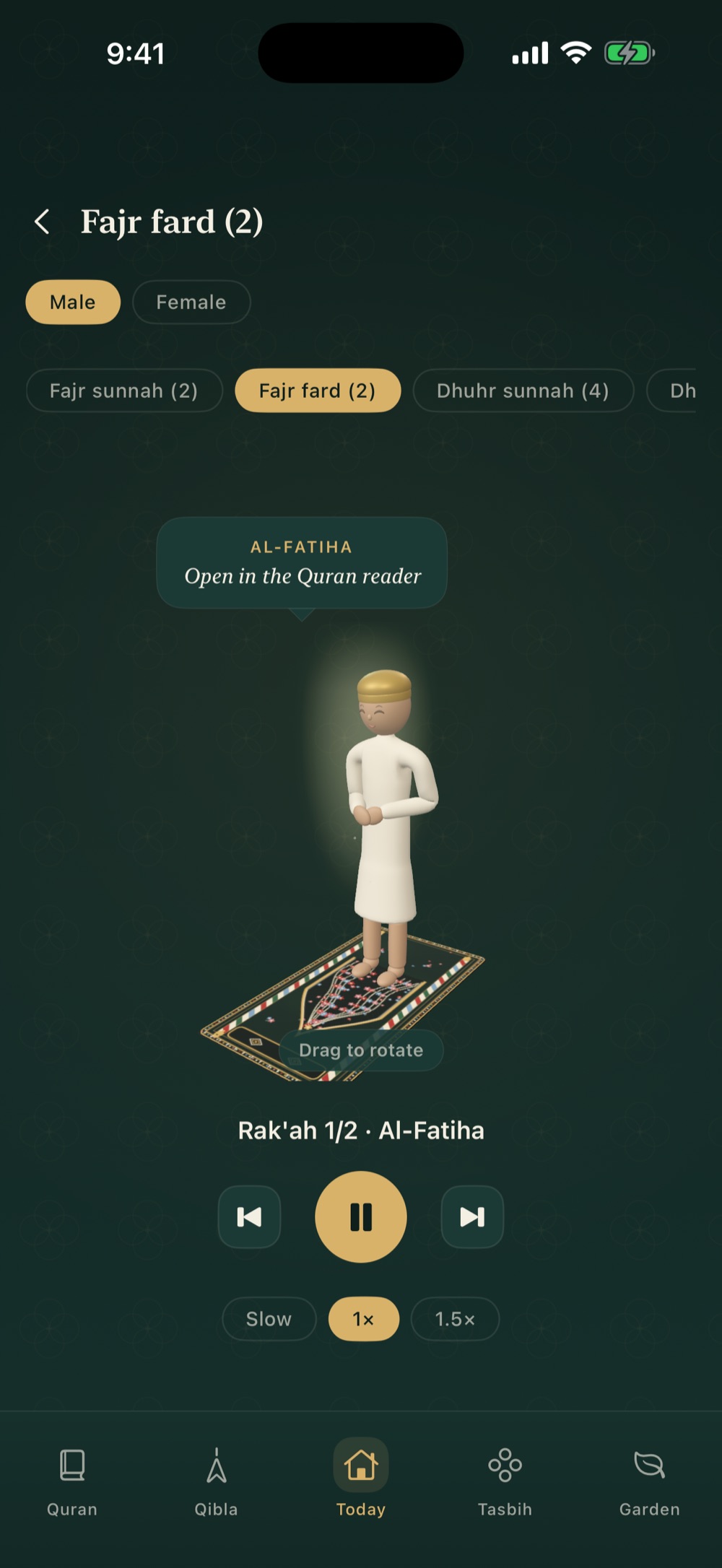
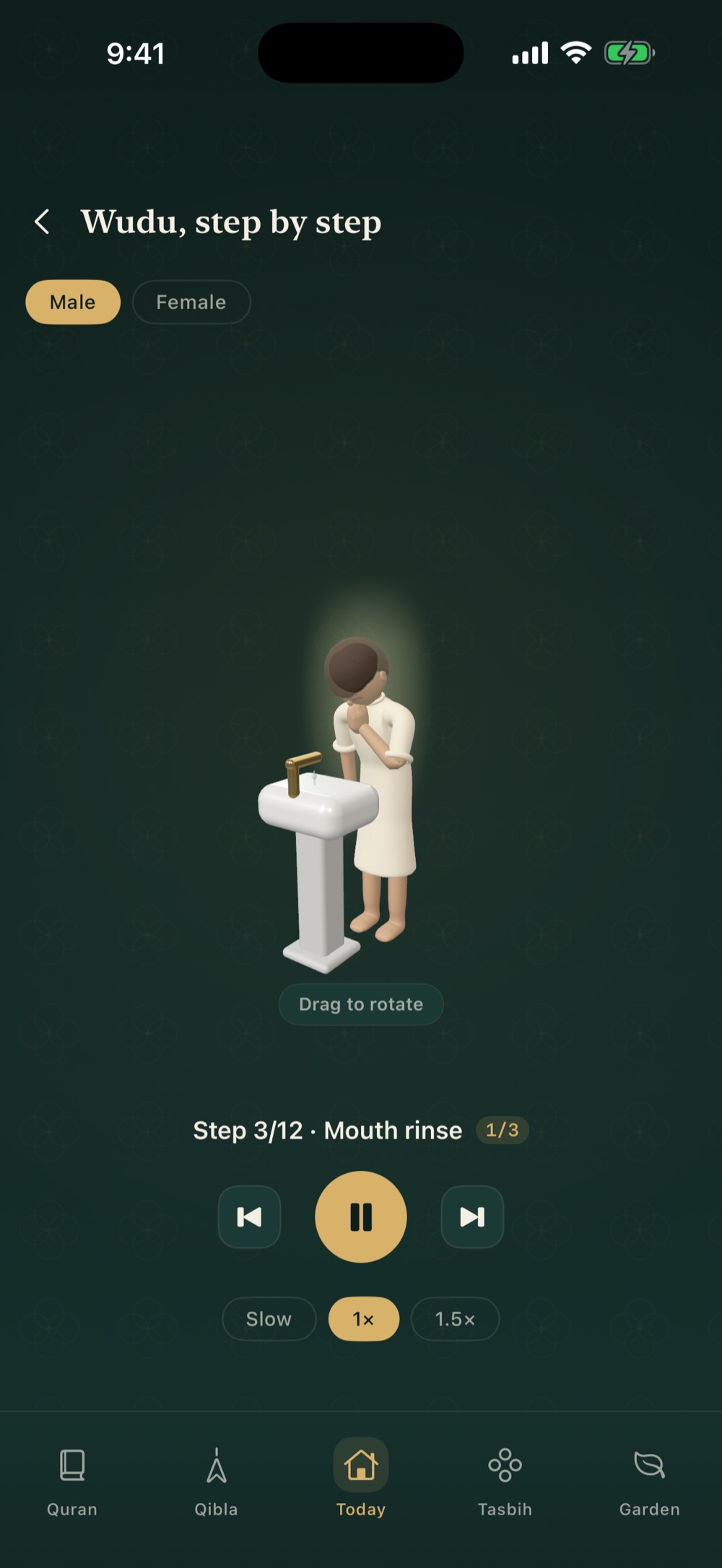
A 3D guide walks every rakʿah of every prayer, position by position, and does the same for wudu. Choose the male or female figure, rotate it with a finger, and tap the verse being recited to open it in the Qurʾān. No prior knowledge assumed, no judgment.
All 114 sūrahs to read, follow along to, or memorize, browsable by sūrah, juz, hizb or your own bookmarks. Close it mid-verse and it opens tomorrow exactly there. Nine reciters, and the verse being recited lights up as the audio moves through it.
A real compass that follows the phone as you turn it, not a picture of an arrow. True bearing, a live fix on where you are, and the distance still to go. 10,496 km from Toronto, and whatever it happens to be from your kitchen.
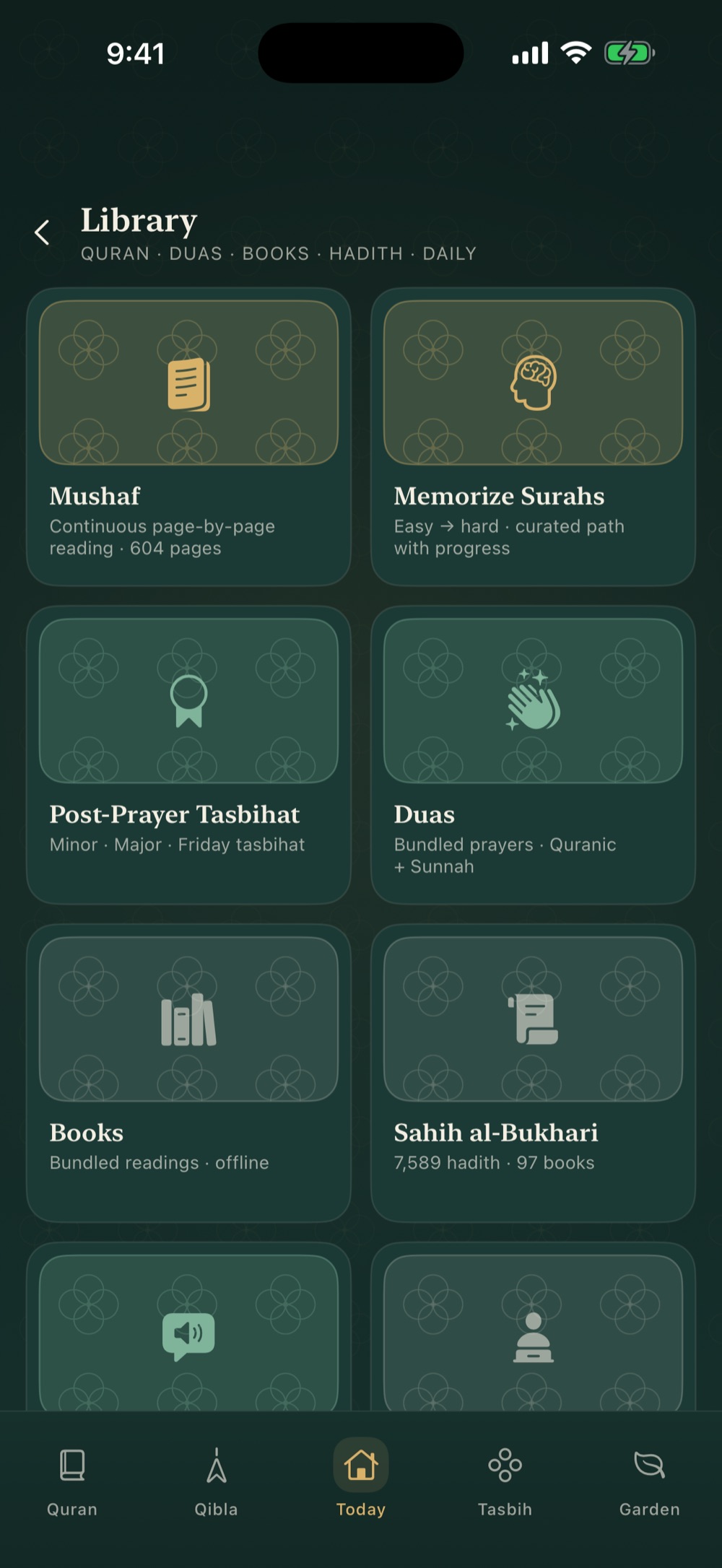
All 7,589 hadith of Ṣaḥīḥ al-Bukhārī. Duas for the occasions you actually meet. The 99 Names. Cevşen. The 25 prophets named in the Qurʾān, each with their story and the verses it is told in. Bring your own PDFs and they sit on the same shelf.
Do I have to open the app to know when to pray?
No. The next prayer can sit on your Home Screen or your Lock Screen and keep its own count. When the time is close the countdown moves to the Lock Screen and the Dynamic Island by itself.
There is an Apple Watch app as well, with the day's times, the Qibla and the tasbih, so the phone can stay in your pocket.
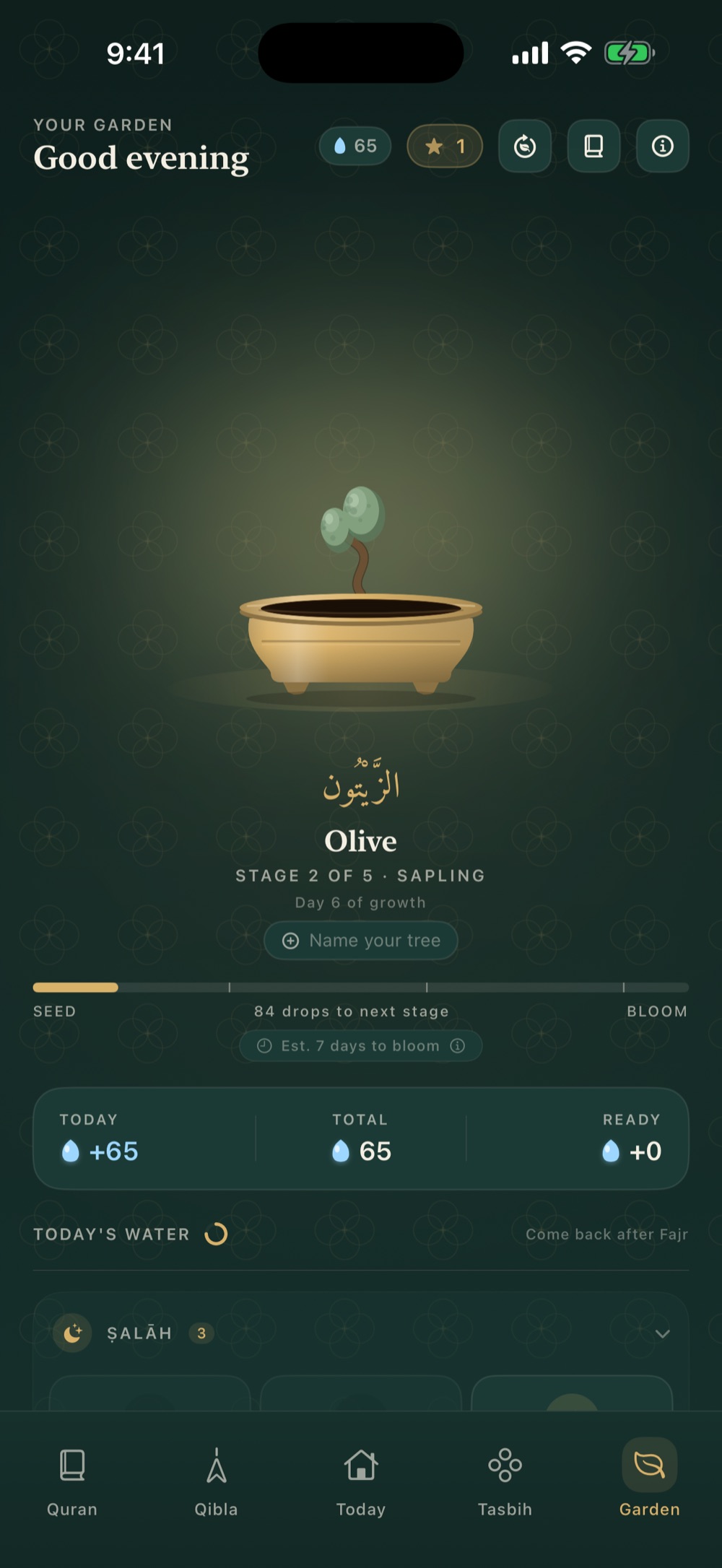
Every prayer, every page, every dhikr waters a tree. Seven species across six stages, earned across days rather than bought. Five are named by Allah in the Qurʾān; two echo the seasons of creation. Day two is bare soil waiting on Fajr, day six is a sapling with another week to bloom, and each tree you bloom unlocks the next.

Five of the seven are named by Allah in the Qurʾān. The maple and the cherry blossom are mine: not scripture, just two trees I love, added so the garden turns with the seasons the way creation does. They are marked that way in the app too, so nobody mistakes my taste for revelation.
Is the garden a game? Can I buy a grown tree?
There is nothing to buy it with. An olive is five hundred drops, roughly four weeks at the pace the app suggests, and every drop comes from something you actually did. Fajr is worth twenty-five, each of the other four prayers fifteen, a page of the Qurʾān ten, a verse memorized twenty.
The trees open in order, each one longer than the last, and nobody else can see yours. The sidr, the lote tree, is the last of the seven, and it can only be planted once you have bloomed the other six. The app's own words for it are that it is encouragement, not a scoreboard.
What changes when you keep opening it, day after day.
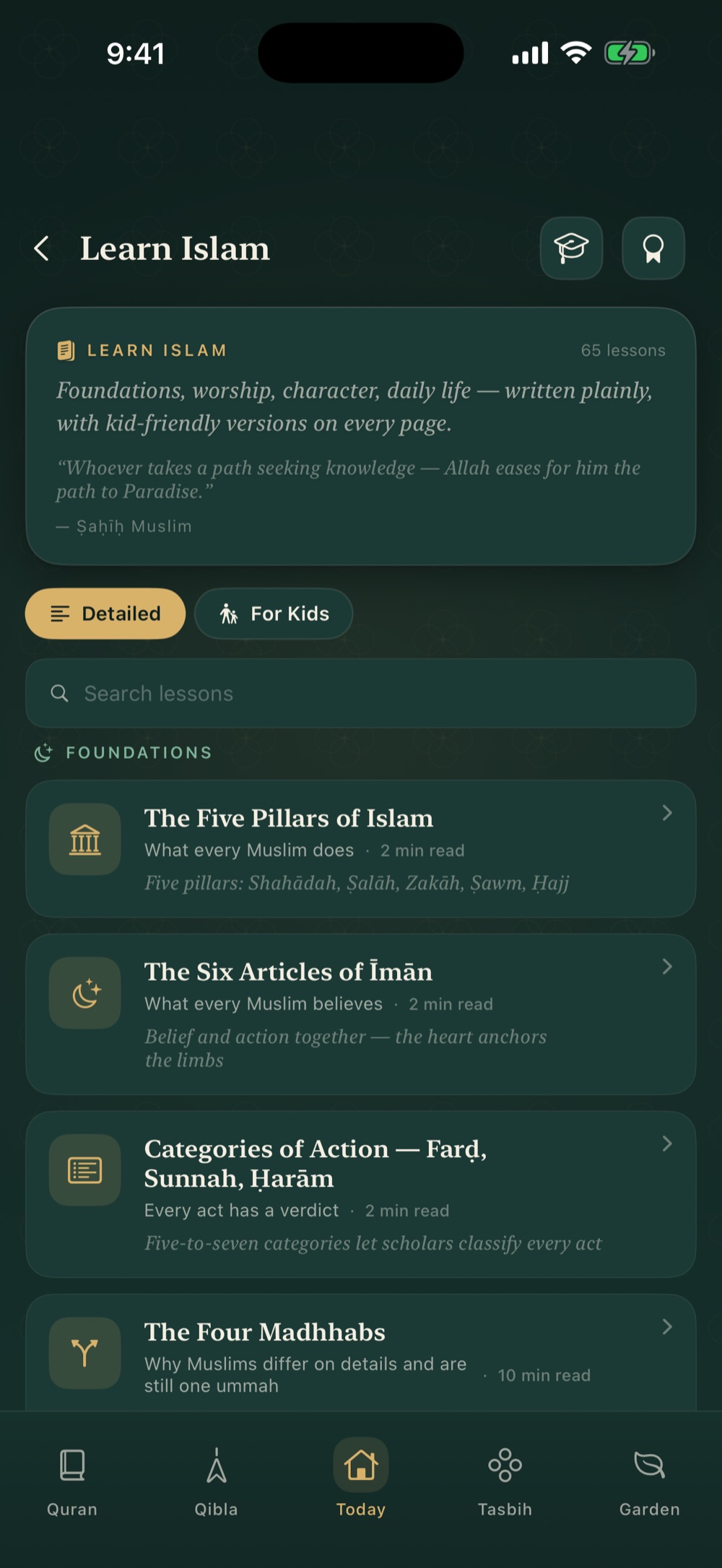
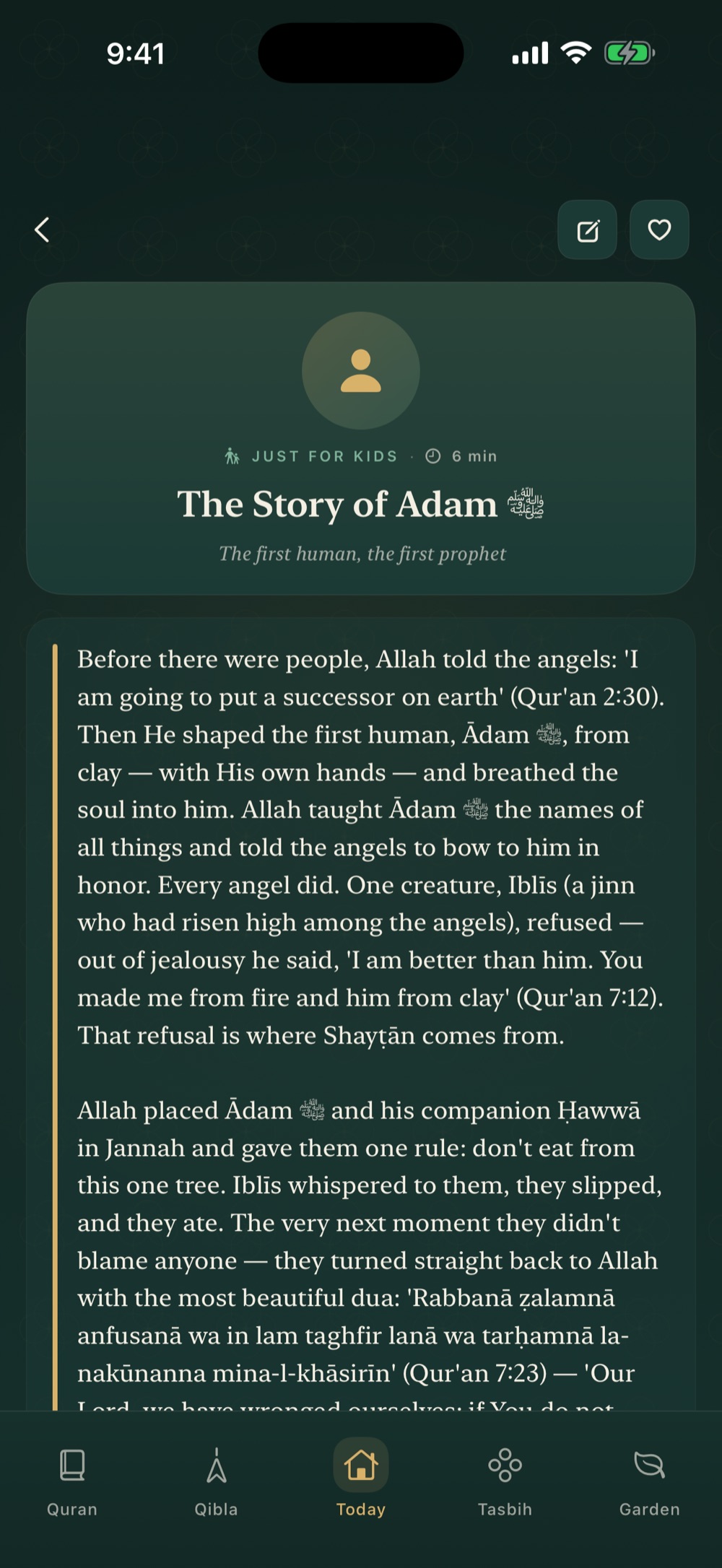
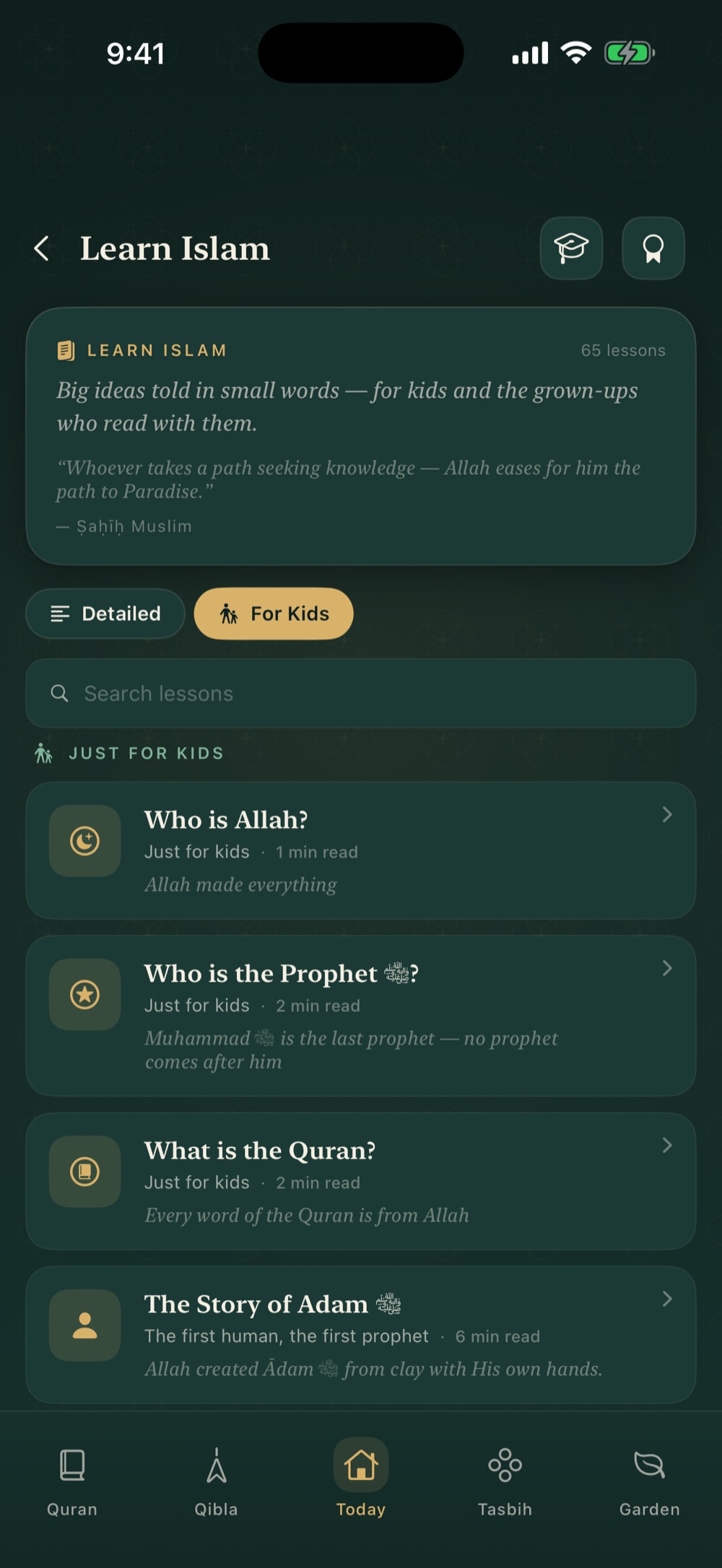
Lessons on the Pillars, on salah, and on akhlāq, written so they make sense whether you grew up with them or are meeting them for the first time. There is a kids' mode with the same material at a different height, for the ones learning alongside you.

Pillars, salah and akhlāq, broken into pieces you can finish in a sitting.

No assumed vocabulary, and every claim traceable to where it comes from.

The same lessons, pitched for a child, without a separate app to buy.
Put it in your hand, set it how you read, and keep it that way.
Forest for the evening, Dawn and Sepia for daylight, Rose and Indigo because not everyone wants green, and a High Contrast set for anyone who needs the text to fight back. Hover any card and the phone here changes to match; click one to keep it.
Every screen, the questions worth asking, and what the app does with what it knows.
Swipe to explore →
These are lifted from the Help and FAQ inside the app, which has around thirty in all.
There is no account to make, so there is nothing to log in to and nothing to lose. There is no advertising and no analytics of any kind. There is no Mizan server for your data to sit on. Your prayer times and the direction to Makkah are worked out on the phone itself.
Three things do go out, and that is the whole list. A Qurʾān translation that is not already built in, fetched once from alquran.cloud and then kept on the phone. Recitation audio from everyayah.com, unless you download a reciter to listen offline. And your coordinate, handed to Apple's own system service so the screen can show the name of your city instead of two numbers. If that last one fails, Mizan just shows the coordinates.
Does it work with no signal?
For the daily things, yes. Prayer times, the Qibla, Tasbih, the Garden, the hadith and the duas are all worked out or stored on the phone, so they need no signal at all. Translations and recitation are fetched once and then kept, and you can download a whole reciter before you go.
If you measure nothing, how will you know when it breaks?
I will not. There is no crash reporter in Mizan and no usage data of any kind, so a bug nobody mentions is a bug I never hear about.
That is the trade: I would rather miss a bug than watch you to catch it. The support page is one person's inbox, and it is the whole feedback system.
It is finished. When can I have it?
Soon. Mizan is coming to the App Store, free, with nothing to sign up for. Everything on this page is in the app already, and there is no paid tier holding any of it back.
Until it lands, the support page is where to find me.
If you would like to
No ads. No account. No data collection of any kind. Nothing about you leaves your phone, and that will not change.
You never have to give anything to use it. If Mizan has earned a place in your day and you would like to support the work, any amount you choose is welcome, and I am grateful for it.
Support MizanWhether you give or not, may your prayers be accepted and your days be at ease.
ٱلَّذِينَ ءَامَنُوا۟ وَتَطْمَئِنُّ قُلُوبُهُم بِذِكْرِ ٱللَّهِ ۗ أَلَا بِذِكْرِ ٱللَّهِ تَطْمَئِنُّ ٱلْقُلُوبُ
“Who have believed and whose hearts have rest in the remembrance of Allah. Verily in the remembrance of Allah do hearts find rest!”
Sūrah Ar-Raʿd · 13:28
Enes Kirgil